There's a version of you that exists in public. At work. In social situations. Even sometimes with the people closest to you. This version is polished. Appropriate. Careful about what she says and how she says it. Always managing the impression she's making.
And then there's the version that exists when you're alone. The one who's tired and uncertain and doesn't have it all figured out. The one who feels things deeply but has learned to keep that depth hidden. The one who's nothing like what people see.
The distance between those two versions? That's where your exhaustion lives.
When you started splitting yourself
You didn't decide one day to become two different people. It happened gradually as you learned which parts of yourself were acceptable and which ones needed to stay hidden.
Maybe you learned early that your real feelings made other people uncomfortable. That your sadness was too heavy, or your anger was too intense, or your excitement was too much. So you started editing those parts out before they could be seen.
Maybe you learned that approval came when you showed up a certain way. Positive. Capable. Easy to be around. And disapproval came when you let the harder parts show. So you learned to present the version that kept people comfortable and hide everything else.
However it happened, you absorbed the message that the real you wasn't quite acceptable as is. That you needed to manage, curate, and perform a more palatable version to move safely through the world.
What the performance costs you
Every interaction becomes a calculation. Before you speak, you're running it through filters. Is this appropriate? Will this make me seem weak? Does this fit the image I've been maintaining? Will this change how they see me in ways I can't control?
You can't just respond naturally because natural might reveal something you've been keeping covered. You can't relax into being yourself because yourself isn't what you've let people believe you are.
The exhaustion isn't from the interactions themselves. It's from the constant management of the gap. The energy required to be one person on the outside while being someone completely different on the inside.
And over time, that gap gets wider. The public version becomes more polished, and the private version becomes more hidden until you're living two separate lives and feeling genuinely alone in both of them.
The loneliness of being unknown
People say they know you. They might even say they love you. But they're loving the version you've let them see. The edited one. The one who doesn't show the messy human parts that you've decided aren't acceptable.
This creates a specific kind of loneliness. You're surrounded by people who care about you and still feel completely unseen. Because who they care about isn't actually you. It's the performance. And the real you has been alone this whole time.
You want to be known, but being known requires showing the parts you've spent years hiding. And showing those parts feels too risky after all this time of keeping them carefully managed.
So you stay lonely in the middle of connection. Known by everyone and understood by no one.
What happens when the gap becomes too wide
Eventually, the performance becomes unsustainable. You can't keep being two different people indefinitely without something breaking down.
Sometimes it shows up as burnout. You're exhausted in ways that sleep doesn't fix because the exhaustion is from the constant splitting. Maintaining two versions of yourself in parallel.
Sometimes it shows up as resentment. Toward the people who only know the public version. Toward yourself for creating a situation where being known feels impossible. Toward the whole arrangement that requires you to hide to be accepted.
Sometimes it shows up as a crisis. A moment where you can't maintain the performance anymore, and everything you've been hiding comes spilling out in ways you can't control.
Closing the distance
You don't have to collapse the gap all at once. You don't have to show up tomorrow as a completely different person and expect everyone to adjust immediately.
But you can start letting small pieces of the real you show through. Testing what happens when you let your guard down just slightly. When you say something true instead of something appropriate. When you let someone see you struggling instead of pretending you have it together.
Some people won't know what to do with it. They've gotten comfortable with the performed version, and the real version will feel unfamiliar. Those relationships might shift or end, and that's information worth having.
But some people will surprise you. They'll meet the real you with relief. With their own truth. With the acknowledgment that they've been performing too, and they're tired of it.
Those are the relationships worth investing in. The ones where closing the gap creates more connection instead of less. Where being real is possible instead of dangerous.
You were never supposed to live two separate lives. The exhaustion you feel is your system telling you that the split is costing too much. That integration is possible. That you can be one whole person instead of two fractured versions.
It won't be comfortable at first. The real you has been hidden for good reasons, and those reasons don't disappear just because you decide to stop hiding.
But the freedom on the other side of closing that gap, of finally being known as who you actually are instead of who you've been performing, that's worth the discomfort of getting there.
The gap between who you are and who you show up as isn't a choice you're making. It's a survival pattern you learned. Understanding which one is yours is the first honest step toward closing it.
Take the two-minute quiz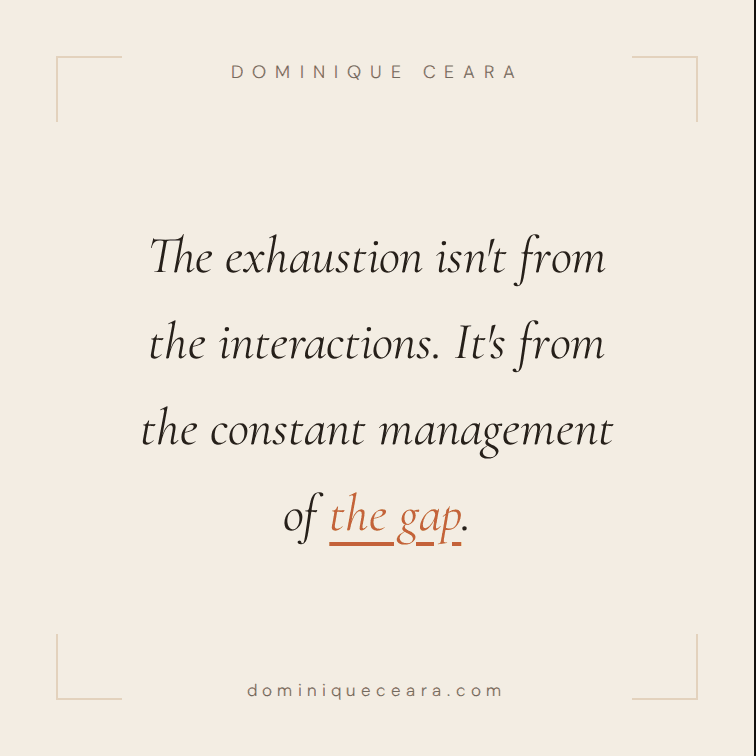
Originally published on Substack
Dominique Ceara
As a certified breathwork instructor, somatic healing practitioner, and life coach, I am dedicated to guiding others on their journey of healing, growth, and transformation. With a unique blend of ancient wisdom and modern techniques, I empower individuals to connect mind, body, and spirit, fostering resilience and clarity in every step of their personal evolution.